


Artificial Intelligence (AI) is no longer a futuristic concept seen only in science fiction movies. Today, AI is part of our daily lives, helping us search the web, navigate roads, create content, translate languages, and even automate business processes.
In 2026, AI has become one of the most important technologies shaping the world. From students and content creators to entrepreneurs and large corporations, everyone is exploring how AI can improve productivity and solve complex problems.
But what exactly is Artificial Intelligence, and why is it becoming so important?
In this beginner-friendly guide, you’ll learn what AI is, how it works, its main types, real-world applications, benefits, challenges, and future trends.
What Is Artificial Intelligence?
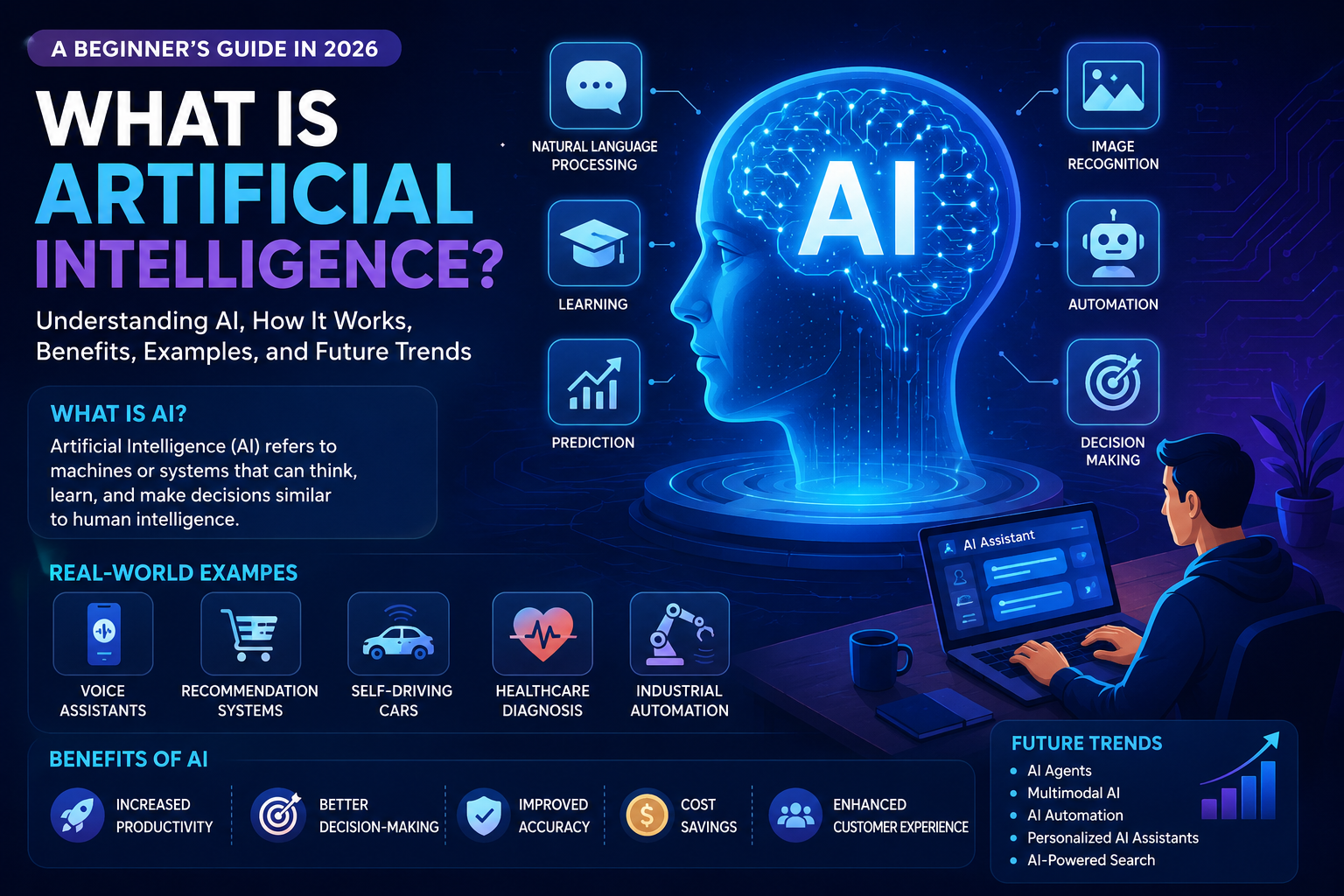
Artificial Intelligence (AI) refers to the ability of computer systems to perform tasks that typically require human intelligence.
These tasks include:
- Learning from data
- Understanding language
- Recognizing images
- Making decisions
- Solving problems
- Predicting outcomes
Simply put, AI enables machines to think, learn, and act in ways that mimic human intelligence.
For example:
- ChatGPT can answer questions and generate text.
- Google Maps predicts traffic conditions.
- Netflix recommends movies based on your interests.
- Virtual assistants like Siri and Google Assistant understand voice commands.
These technologies use AI to improve user experiences and automate complex processes.
How Does Artificial Intelligence Work?
AI works by processing large amounts of data and identifying patterns within that data.
The basic process includes:
1. Data Collection
AI systems need data to learn.
Examples:
- Images
- Videos
- Text documents
- User behavior
- Sensor information
The more high-quality data available, the better the AI system can perform.
2. Training the Model
Developers use algorithms to train AI models.
During training, the AI learns patterns and relationships from the provided data.
For example:
An AI image recognition system learns what a cat looks like by analyzing thousands of cat photos.
3. Making Predictions
After training, AI can make predictions or decisions based on new information.
Examples:
- Detecting spam emails
- Recommending products
- Predicting weather conditions
- Generating text responses
4. Continuous Improvement
Modern AI systems continue learning and improving over time as they receive more data and feedback.
Types of Artificial Intelligence
AI can be categorized into different levels.
Narrow AI
Narrow AI is designed for specific tasks.
Examples:
- ChatGPT
- Google Translate
- Face Recognition Systems
- Recommendation Algorithms
Most AI applications used today belong to this category.
General AI
General AI refers to systems capable of performing any intellectual task that humans can do.
Currently, General AI remains a theoretical concept and has not yet been fully achieved.
Super AI
Super AI is a hypothetical future form of intelligence that surpasses human cognitive abilities.
This concept is often discussed in research and science fiction.
AI vs Machine Learning vs Deep Learning
Many beginners confuse these terms.
Artificial Intelligence (AI)
The broad concept of machines performing intelligent tasks.
Machine Learning (ML)
A subset of AI that allows systems to learn from data without explicit programming.
Deep Learning (DL)
A specialized branch of machine learning that uses neural networks to process complex information.
Think of it this way:
Artificial Intelligence
    └── Machine Learning
            └── Deep Learning
Deep Learning powers many advanced technologies, including image generation and voice recognition.
Real-World Examples of Artificial Intelligence
AI is already everywhere.
Healthcare
AI helps doctors:
- Analyze medical images
- Detect diseases early
- Recommend treatments
Education
AI-powered learning platforms can:
- Personalize lessons
- Generate quizzes
- Assist students with research
Business
Companies use AI for:
- Customer support
- Marketing automation
- Sales forecasting
- Data analysis
Finance
Banks utilize AI to:
- Detect fraud
- Evaluate credit risk
- Automate customer service
Content Creation
AI tools help create:
- Blog posts
- Videos
- Images
- Social media content
Benefits of Artificial Intelligence
Increased Productivity
AI automates repetitive tasks, allowing people to focus on more important work.
Faster Decision-Making
AI can analyze large datasets much faster than humans.
Improved Accuracy
AI reduces human errors in many situations.
Cost Savings
Businesses can reduce operational costs through automation.
Better Customer Experiences
AI-powered chatbots and recommendation systems improve user satisfaction.
Challenges and Risks of AI
Despite its advantages, AI also presents challenges.
Privacy Concerns
AI systems often rely on large amounts of user data.
Job Displacement
Automation may replace some repetitive jobs.
Bias and Fairness
AI models can sometimes inherit biases from training data.
Security Risks
Cybercriminals may misuse AI technologies.
Ethical Issues
Questions about transparency and accountability remain important.
Responsible AI development is crucial to ensuring positive outcomes.
Why AI Matters in 2026
AI is no longer optional for businesses and professionals.
Organizations that embrace AI gain advantages such as:
- Higher efficiency
- Better customer service
- Improved decision-making
- Increased competitiveness
Individuals who learn AI skills are also more likely to remain competitive in the evolving job market.
AI literacy is becoming as important as digital literacy.
Future Trends of Artificial Intelligence
Several trends are expected to shape AI in the coming years.
AI Agents
AI systems capable of completing complex tasks autonomously.
Multimodal AI
Models that understand text, images, audio, and video simultaneously.
AI Automation
Businesses increasingly automate workflows using AI-powered tools.
Personalized AI Assistants
Future AI assistants will become more customized to individual users.
AI-Powered Search
Search engines are integrating AI-generated answers directly into search results.
Frequently Asked Questions
Is Artificial Intelligence the same as Machine Learning?
No. Machine Learning is a subset of Artificial Intelligence.
Can AI think like humans?
Current AI systems do not think or understand in the same way humans do.
Is AI dangerous?
AI itself is not inherently dangerous, but misuse and poor regulation can create risks.
Will AI replace jobs?
AI may automate certain tasks, but it will also create new opportunities and professions.
How can beginners start learning AI?
Start by understanding basic concepts, experimenting with AI tools, and learning how AI is used in real-world applications.
Conclusion
Artificial Intelligence is transforming the way people live, work, and interact with technology. From virtual assistants and recommendation systems to content creation and business automation, AI is becoming an essential part of modern life.
Understanding the fundamentals of AI is the first step toward taking advantage of its opportunities. Whether you are a student, entrepreneur, content creator, or technology enthusiast, learning about AI today can help you stay ahead in the digital future.
As AI continues to evolve in 2026 and beyond, those who embrace and understand this technology will be better prepared for the opportunities it brings.